

I. Introduction
In our daily lives, we often encounter various substances that play essential roles in different applications.
Calcium carbonate and sodium bicarbonate are two such compounds that you may come across more frequently than you realize.
- Calcium carbonate, with its chemical formula CaCO3, is commonly found in nature as limestone, chalk, and marble. It is also a key ingredient in dietary supplements and antacids.
- On the other hand, sodium bicarbonate, known as baking soda with the formula NaHCO3, is a staple in our kitchens, used for baking, cleaning, and even personal care.
While both compounds share some similarities in their basic properties, they also possess distinct characteristics that make them suitable for specific uses.
Understanding the differences between calcium carbonate and sodium bicarbonate is not only fascinating from a scientific perspective but also crucial for making informed decisions in various aspects of life, whether it’s choosing the right product for a particular task or understanding their impact on our health and the environment.
In this article, we will delve deep into the world of these two compounds, exploring their chemical properties, physical characteristics, common uses, and more, to help you gain a comprehensive understanding of calcium carbonate and sodium bicarbonate.
II. Chemical Properties
A. Chemical Formulas and Basic Structures
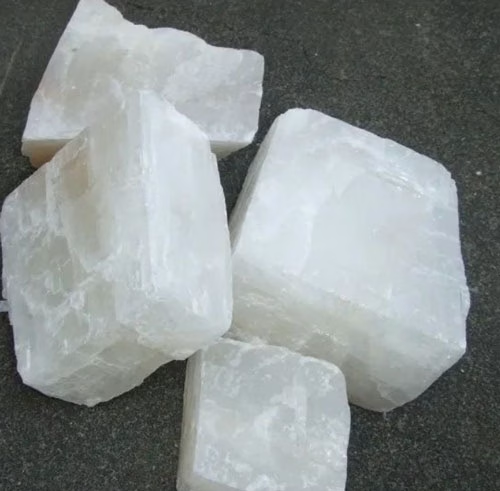
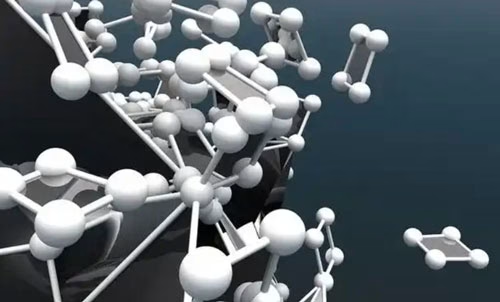
Calcium carbonate has the chemical formula CaCO3, consisting of one calcium (Ca) atom, one carbon (C) atom, and three oxygen (O) atoms. The carbon atom is centrally located, bonded to the calcium atom and surrounded by three oxygen atoms in a trigonal planar arrangement. This structure gives calcium carbonate its characteristic stability. In nature, it can be found in different crystalline forms such as calcite, aragonite, and vaterite, each with slightly different physical properties due to variations in the packing of the atoms. Calcite is the most common and stable form, often seen in limestone and marble.
B. Solubility in Water
Calcium carbonate is sparingly soluble in water. At room temperature, only a very small amount of calcium carbonate can dissolve in water, approximately 0.0014 grams per 100 milliliters of water. This low solubility is due to the strong ionic bonds within the compound, which require a significant amount of energy to break for dissolution to occur. As the temperature increases, the solubility of calcium carbonate in water does not change significantly. In fact, it is one of the few substances whose solubility is relatively unaffected by temperature changes over a wide range. This property is crucial in understanding phenomena like the formation of limestone caves, where calcium carbonate precipitates out of water over time, creating stalactites and stalagmites.

C. pH Levels and Alkalinity
When calcium carbonate is added to water, it hydrolyzes slightly, producing a weakly alkaline solution. The pH of a saturated calcium carbonate solution is around 9.5 – 10.5. The alkalinity arises because the carbonate and bicarbonate ions can accept protons (H⁺) from water, increasing the hydroxide ion (OH⁻) concentration. However, due to its low solubility, the overall alkalinity contribution in most aqueous systems is relatively small. In environmental applications, such as in lakes and rivers, the presence of calcium carbonate can act as a buffer, helping to maintain a relatively stable pH and prevent rapid acidification.
In contrast, Sodium bicarbonate, with the formula NaHCO₃, sodium bicarbonate is much more soluble in water, forms a weakly alkaline solution. The pH of a typical sodium bicarbonate solution is around 8.3 – 8.4. For more details, please read the explanation of sodium bicarbonate in article: Sodium Carbonate vs Sodium Bicarbonate.
III. Common Applications
A. In the Food Industry
In the food industry, both calcium carbonate and sodium bicarbonate serve important functions. Sodium bicarbonate, as we know, is a crucial leavening agent in baking. When used in cake or bread recipes, it reacts with acidic components like buttermilk, vinegar, or cream of tartar. The reaction produces carbon dioxide gas, which gets trapped in the dough or batter, causing it to expand and rise. This gives baked goods their characteristic fluffy and light texture. For example, in a classic chocolate chip cookie recipe, a teaspoon of baking soda can make the difference between a flat, dense cookie and a thick, chewy one.

Calcium carbonate, on the other hand, is often used as a dietary calcium supplement in fortified foods. It can be added to orange juice, milk alternatives, and cereals to boost their calcium content. This is especially important for individuals who may not consume enough dairy products, such as vegans or those with lactose intolerance. Additionally, calcium carbonate is used in some food products as an anti-caking agent, preventing ingredients from clumping together. In powdered spices or powdered drink mixes, a small amount of calcium carbonate helps maintain a free-flowing texture, ensuring even distribution of the product when used.
B. In Medicine and Healthcare
In medicine and healthcare, the roles of these two compounds are distinct. Sodium bicarbonate is commonly used to treat acidosis, a condition where the body’s pH becomes too acidic. It can be administered intravenously in severe cases, such as in diabetic ketoacidosis, to help neutralize the excess acid in the blood and restore the body’s normal pH balance. In a more everyday context, it is used as an antacid to relieve heartburn and indigestion. When stomach acid levels are too high, sodium bicarbonate reacts with the acid, reducing its acidity and providing relief. However, it should be used with caution as excessive use can lead to alkalosis, a condition where the body becomes too alkaline.
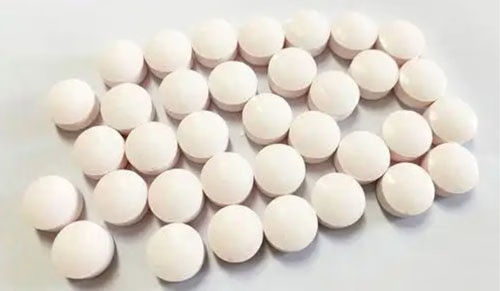
Calcium carbonate is a popular choice for calcium supplementation. It is available in various forms, such as tablets and chewables, and is often prescribed to individuals at risk of osteoporosis or those with low calcium intake. It provides a significant amount of elemental calcium per dose, helping to maintain strong bones and teeth. In addition, calcium carbonate is an ingredient in some over-the-counter antacids. It works by neutralizing stomach acid, similar to sodium bicarbonate, but has a slower and more sustained action. It is important to note that when taking calcium supplements, it should be done under the guidance of a healthcare professional, as excessive calcium intake can have negative effects on the kidneys and other organs.
C. In Industrial Production
In industrial production, calcium carbonate and sodium bicarbonate find diverse applications. Calcium carbonate is a key ingredient in the construction industry. In the production of cement, it is used as a raw material. When limestone (calcium carbonate) is heated in a kiln, it decomposes to form calcium oxide (quicklime), which is then further processed to make cement. In addition, in the manufacturing of plastics, paints, and paper, calcium carbonate is added as a filler. It improves the physical properties of these materials, such as increasing the hardness and opacity of plastics, enhancing the brightness and smoothness of paper, and providing better coverage in paints.

Sodium bicarbonate has important uses in the fire extinguishing industry. It is a major component in some dry chemical fire extinguishers. When the extinguisher is activated, the heat causes the sodium bicarbonate to decompose, releasing carbon dioxide gas. The carbon dioxide displaces oxygen, smothering the fire and preventing its spread. In the environmental sector, sodium bicarbonate can be used in water treatment. It can help adjust the pH of acidic industrial wastewaters, making them less harmful to the environment before discharge. It also has applications in flue gas desulfurization processes in power plants, where it reacts with sulfur dioxide in the exhaust gases to reduce air pollution.
IV. Case Studies and Research Findings
A. Research in Material Science
In the field of material science, extensive research has been conducted on both calcium carbonate and sodium bicarbonate to explore their potential applications and enhance material properties. For instance, studies on calcium carbonate have focused on its use as a filler in polymer composites. Researchers have found that by incorporating nano-sized calcium carbonate particles into polymers, the mechanical properties of the composites can be significantly improved. In one study, when nano-calcium carbonate was added to polyethylene terephthalate (PET), the tensile strength and modulus of the resulting composite increased by up to 30% compared to pure PET. This is because the fine calcium carbonate particles can act as reinforcing agents, distributing stress evenly within the polymer matrix and preventing crack propagation. The surface modification of calcium carbonate has also been a key area of research. By treating the surface of calcium carbonate with coupling agents, its compatibility with polymers can be enhanced, leading to better dispersion and stronger interfacial bonding.
Sodium bicarbonate has also found interesting applications in material science, especially in the development of smart materials. Recent research has explored its use in the synthesis of stimuli-responsive materials. Scientists have incorporated sodium bicarbonate into hydrogel systems, which can respond to changes in temperature or pH. In a particular study, a hydrogel containing sodium bicarbonate was designed to release carbon dioxide gas upon exposure to acidic conditions. This property was utilized in a drug delivery system, where the hydrogel could release encapsulated drugs in a controlled manner in the acidic environment of the stomach. The gas release also provided an additional mechanism for enhancing the diffusion of the drug, improving its bioavailability. Such innovative applications of sodium bicarbonate in material design open up new possibilities for targeted drug delivery and other biomedical applications.

B. Environmental Science Research
In environmental science, the roles of calcium carbonate and sodium bicarbonate are crucial in understanding and addressing various ecological challenges. Calcium carbonate is a significant player in the carbon cycle and has been studied for its potential in carbon sequestration. Research has shown that in marine environments, organisms like corals and mollusks use calcium carbonate to build their shells and skeletons. This process effectively removes carbon dioxide from the water, as the formation of calcium carbonate from calcium ions and bicarbonate ions in seawater leads to the precipitation of solid calcium carbonate. Over time, these calcium carbonate structures can accumulate on the ocean floor, acting as a long-term carbon sink. In addition, in terrestrial ecosystems, the presence of calcium carbonate in soils can influence soil fertility and carbon storage. Soils rich in calcium carbonate can buffer against acidification, protecting soil microorganisms and maintaining a favorable environment for plant growth.

Sodium bicarbonate has been investigated for its potential in water treatment and environmental remediation. In some studies, it has been used to mitigate the effects of acid mine drainage, a major environmental issue in mining areas. Acid mine drainage contains high concentrations of sulfuric acid and heavy metals, which can contaminate water bodies and harm aquatic life. Sodium bicarbonate can be added to the drainage to neutralize the acid, raising the pH and precipitating out some of the heavy metals as hydroxides. In laboratory experiments, the addition of sodium bicarbonate to acid mine drainage samples led to a significant increase in pH, reducing the acidity to levels more suitable for aquatic organisms. It also facilitated the removal of heavy metals such as iron and copper, with removal efficiencies reaching up to 80% in some cases. This application of sodium bicarbonate offers a cost-effective and relatively simple solution for treating acid mine drainage and protecting water quality in affected regions.

V. Conclusion
Calcium carbonate and sodium bicarbonate, though seemingly ordinary substances, possess a myriad of unique properties and applications that impact our daily lives in diverse ways.
- Calcium carbonate, with its abundance and stability, has firmly established its place in industries ranging from construction to food and medicine. It serves as a reliable filler, a crucial dietary supplement, and an effective antacid.
- On the other hand, sodium bicarbonate, with its high solubility and reactivity, reigns supreme in the kitchen as a leavening agent and extends its utility to healthcare and fire protection.
Each compound has its own set of advantages and disadvantages. Calcium carbonate’s low solubility can be a hindrance in some processes, while sodium bicarbonate’s instability requires careful handling and storage.
Understanding these nuances is essential for making the most appropriate choices in various scenarios, be it formulating a recipe, developing a new material, or addressing an environmental issue.
As research progresses, we can anticipate further breakthroughs in the utilization of these compounds. Future studies may uncover novel ways to enhance their performance, expand their applications, and mitigate any associated drawbacks. Whether it’s through innovative material designs in nanotechnology or more sustainable environmental solutions, calcium carbonate and sodium bicarbonate will continue to play starring roles in the scientific and industrial arenas, shaping the way we live and interact with the world around us.

