

I.Introduction
Dibasic Calcium Phosphate, also known as calcium hydrogen phosphate, has the chemical formula CaHPO4. In its hydrated form, it is often written as CaHPO4·2H2O. It is commonly abbreviated as DCP. This compound is a white, odorless, and tasteless powder. It is sparingly soluble in water but soluble in dilute acids and alkalis.
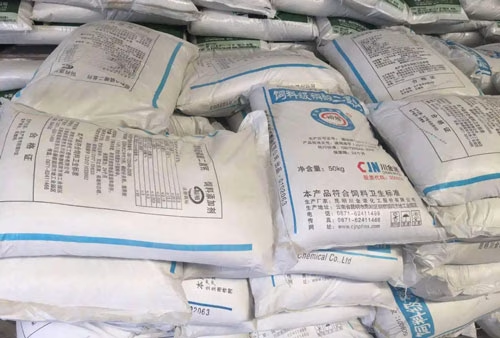
Calcium Phosphate, on the other hand, is a more general term that refers to a family of minerals containing calcium ions (Ca2+) and phosphate ions (PO43 -). The most common form is Tricalcium Phosphate with the formula Ca3(PO4)2, often abbreviated as TCP. It is a white solid that is insoluble in water but soluble in acids.
II.Production and Preparation
2.1 Production Methods
In the industrial production of Dibasic Calcium Phosphate, the most prevalent methods is the reaction between industrial phosphoric acid and lime milk or calcium carbonate for neutralization.

The production of Calcium Phosphate, especially tricalcium phosphate (Ca3(PO4) 2), typically involves extraction and preparation from raw materials such as phosphate rock.
One common approach is the reaction of phosphate rock with sulfuric acid to first produce phosphoric acid. The obtained phosphoric acid then undergoes further reactions to form calcium phosphate.
In some cases, high temperature processes are also used to produce calcium phosphate with specific crystal structures.
Another method for producing calcium phosphate is through the reaction of calcium salts and phosphate salts in solution.
2.2 Production Complexity and Cost
The production complexity of Dibasic Calcium Phosphate and Calcium Phosphate shows some differences.
The production of dibasic calcium phosphate, especially through the reaction of phosphoric acid with lime milk or calcium carbonate, is relatively straightforward in terms of the basic reaction steps. However, achieving high – purity products often requires careful control of reaction conditions and subsequent purification steps.

In contrast, the production of calcium phosphate, especially when starting from phosphate rock, involves multiple steps, including the extraction of phosphoric acid from the rock, which is a complex process with potential environmental impacts due to the generation of by – products such as hydrogen fluoride and calcium sulfate. The subsequent reactions to form calcium phosphate also require precise control, and the high – temperature processes for obtaining specific crystal structures add an additional layer of complexity.
Regarding to the cost, in general, if all other factors are equal, the production cost of calcium phosphate may be relatively higher than that of dibasic calcium phosphate due to the more complex production process and higher energy consumption, especially when high – temperature processes are involved. However, in specific production scenarios, the cost can be influenced by the availability and price of raw materials, as well as the scale of production.
III.Applications in Various Industries
3.1 In the Medical and Healthcare Field

3.1.1 Uses of Dibasic Calcium Phosphate
Calcium supplement.
Another advantage of using Dibasic Calcium Phosphate as a calcium supplement is its relatively high solubility in the acidic environment of the stomach compared to some other calcium – containing compounds. This solubility allows for efficient absorption of calcium. For example, compared to calcium carbonate, which is also a common calcium supplement, Dibasic Calcium Phosphate may be better tolerated by some individuals, especially those with reduced stomach acid production. Calcium carbonate requires a more acidic environment for complete dissolution, and in some people with low – acid conditions, its absorption may be impaired.
Excipient for tablets

Dibasic Calcium Phosphate is also widely used as an excipient in pharmaceutical tablets (for detail explanation please read “what is calcium hydrogen phosphate anhydrous excipient”).
3.1.2 Uses of Calcium Phosphate
Bone repair and regeneration
When used as a bone grafting material, calcium phosphate ceramics, such as β – tricalcium phosphate, can act as a scaffold for new bone growth. The porous structure of these ceramics allows for the infiltration of osteoblasts (bone – forming cells) and the deposition of new bone tissue.
In addition, calcium phosphate has the ability to degrade gradually in the body over time, so it can be used to fill the defect and promote bone healing.

Treatment of digestive disorders
Calcium Phosphate can be used as an antacid or a phosphate binder in cases of hyperphosphatemia (high levels of phosphate in the blood). It helps to neutralize the acid and relieve symptoms of heartburn and indigestion and helps to control the phosphate levels in the body and prevent complications associated with high phosphate levels, such as bone – mineral disorders and cardiovascular problems.
3.2 In the Food Industry
3.2.1 Roles of Dibasic Calcium Phosphate
Nutrient supplement
Dibasic Calcium Phosphate provides a convenient source of Calcium and phosphorus. In many processed foods, especially those targeted at specific consumer groups such as children, the elderly, or individuals with dietary restrictions, the addition of Dibasic Calcium Phosphate can help to meet the recommended daily intake of these minerals. For example, in fortified breakfast cereals, it is often added to increase the calcium and phosphorus content.
Leavening agent in baking
In a typical cake recipe, the addition of Dibasic Calcium Phosphate along with baking powder (which contains sodium bicarbonate and an acidic component) helps to create a well – risen and tender cake.

Buffering agent
By acting as a buffer, Dibasic Calcium Phosphate helps to maintain the integrity of the product and extend its shelf life.
3.2.2 Roles of Calcium Phosphate
Anti caking agent
The small particles of calcium phosphate can inhibit the formation of clumps in powdered food products such as milk powder, cocoa powder, and some seasonings.
Moisture retaining agent
Calcium Phosphate can absorb and retain moisture, helping to keep the product moist and fresh for a longer period for bread, cakes and meats.

Nutrient fortifying agent
Similar to Dibasic Calcium Phosphate, in products like fortified juices and ready to eat meals, the addition of calcium phosphate can increase the calcium content, making the product more nutritious.
3.3 In the Feed Industry
3.3.1 Contributions of Dibasic Calcium Phosphate
In the feed industry, Dibasic Calcium Phosphate is a vital ingredient for animal nutrition. It provides the calcium and phosphorus are two of the most important minerals for the growth and development of animals.

3.3.2 Contributions of Calcium Phosphate
Calcium Phosphate is also used to provide the calcium and phosphorus, especially in the production of pet foods. Pets, such as dogs and cats.
In addition, calcium phosphate also have a positive impact on the digestion and absorption of other nutrients. It can help to improve the utilization of protein, carbohydrates, and fats in the animal’s body.

IV.Conclusion
Throughout this exploration, we have identified several key differences between Dibasic Calcium Phosphate and Calcium Phosphate in their production methods and applications.
As industries continue to evolve and demand more sustainable, efficient, and safe products, the research and development of Dibasic Calcium Phosphate and Calcium Phosphate will play a crucial role in meeting these challenges and providing innovative solutions in the medical, food, and feed industries.
Expand reading:

